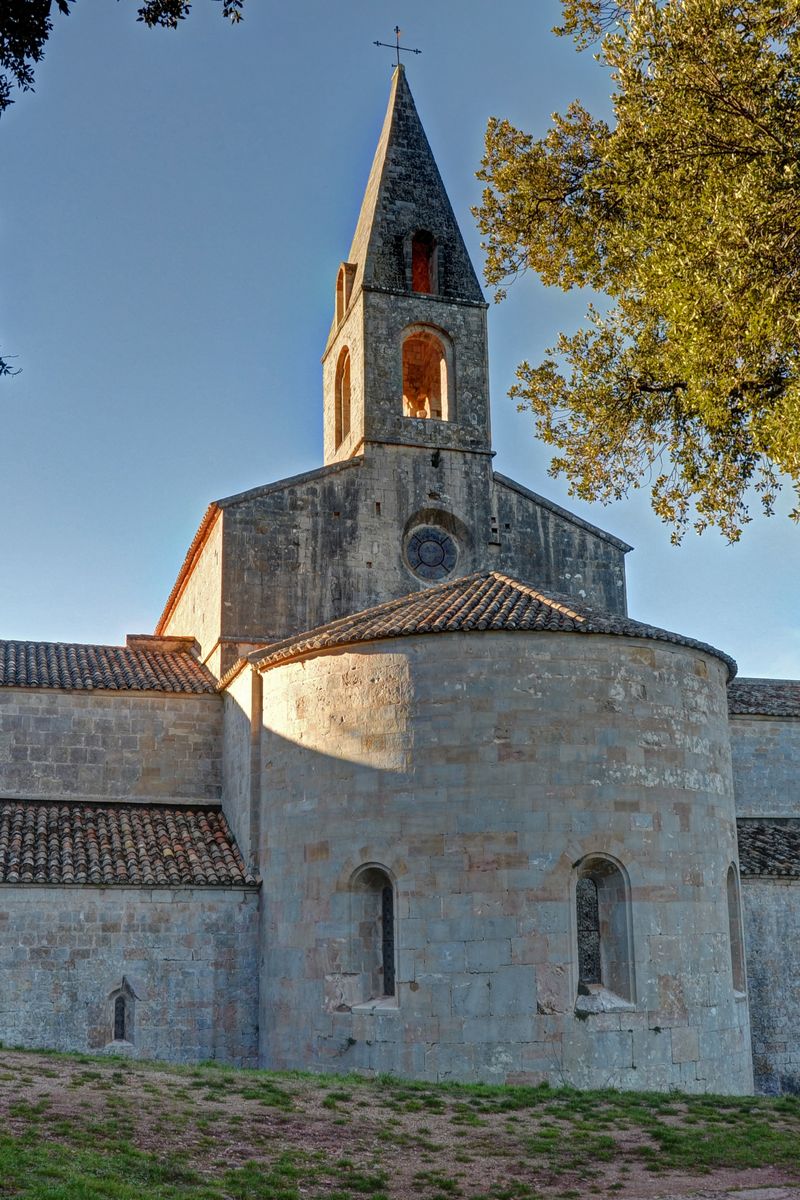
Thoronet Abbey stands alone in a wooded valley in the Var, in inland Provence — a Cistercian monastery built in pale local limestone between the 1160s and 1200, on a site the monks settled around 1157 after moving from an earlier foundation of 1136. It is one of the "Three Sisters" of Provençal Cistercian architecture, alongside Sénanque and Silvacane, and is widely considered the most austere and best-preserved of the three — a pure expression of the Cistercian ideal that ornament distracts from prayer, so nothing here is decorated beyond the bare geometry of stone, light and volume.
The Cistercian order, founded in 1098 at Cîteaux as a return to a stricter reading of the Benedictine rule, built for silence and self-sufficiency rather than display, and Thoronet's builders carried that discipline further than almost anywhere else: a barrel-vaulted church without a single carved figure, a cloister of plain double arcades on a sloping site, a hexagonal lavabo where the monks washed before meals, and a chapter house with the abbey's finest cross-ribbed vaulting. The stone itself became the abbey's only ornament — its walls are famous for a natural echo so long and clear that the monks were said to have had to sing slowly and in perfect unison to avoid the sound overlapping itself, a quality that still draws musicians and choirs to the abbey today.
The community declined from the 14th century, reduced by famine and plague to a handful of monks by the 1430s, and the abbey was dissolved and sold off in 1785. Rescued from ruin after being listed as a historic monument in 1840, it has been restored ever since and is now cared for as a national historic monument. In the 20th century the architect Le Corbusier visited Thoronet and wrote of its "light and shadow" as "the loudspeakers of this architecture of truth" — a visit that shaped his design for the Sainte-Marie de La Tourette convent near Lyon. We handle the ticketing so your open-date admission is confirmed before you arrive, leaving you free to simply walk in and take the silence at your own pace.